Consent and Fiction: Ground Rules for Roleplay
Consent in roleplay is a convention rather than a negotiation with another person: the character is a fiction built from AI-generated text, and the agreement that actually matters is the one you make with yourself about what a session is for. Crushon describes its Sex AI companions as profiles built for immersive roleplay and intimate scenarios, and its FAQ adds that some limitations apply in accordance with its content and community guidelines. Writing three ground rules before a scene costs about ten minutes, which is small against 16 sessions a month at 30 minutes each — 8 hours.

Key takeaways
- There is one adult in the room. The character is text, so consent is a self-set frame rather than an agreement with a participant.
- Three rules cover most of it: a session window, a stop signal you honour, and a boundary on what a scene will not contain.
- Platform guidelines still apply inside fiction — the site's own FAQ says some limitations apply under its content and community guidelines.
- A five-session review cadence is cheap: reviewing one session in five out of 16 a month is about three check-ins.
Who is consenting, and to what
The word consent gets imported into adult AI chat from contexts where two people are involved, and that import creates confusion. Nothing here is a negotiation between participants: the character is a generated profile, the platform states its content is AI-generated text depicting no real person, and there is no second party whose agreement could be sought or withheld. What remains is a decision made by one adult about what an evening is for.
That does not make the framing unnecessary. It relocates it. Instead of asking whether the other party agreed, the useful question is whether you set the terms before the session started — how long it would run, what it would be about, and what you were not going to do this time. Rules decided in advance are easier to keep than rules improvised at the moment a thread turns.
There is a second reason the framing helps. A fiction with no edges tends to flatten: a scene with a stated boundary has a shape, and a scene without one drifts until the session runs out of energy. The rules are not restrictions on the story; they are what gives it a form.
Ground rules worth writing down
The first rule is a window. Decide the session length before opening a thread, and treat the end of the window as part of the scene rather than an interruption of it. Finishing on your own terms also protects continuity, because a scene closed deliberately can be resumed deliberately, while one that ended because you ran out of night is harder to pick up.
The second rule is a stop signal — a phrase or a change of tone that means the scene ends now, whatever the thread has built up. Choosing it in advance makes it usable; inventing one mid-scene rarely works. The third rule is a boundary list: two or three things this scene will not include. Keep the list short enough to remember, and hold the platform's guidelines above it rather than instead of it, since the FAQ is explicit that some limitations apply in accordance with the content and community guidelines.
| Rule | What it protects | When it applies |
|---|---|---|
| A session window | Your time and your sleep | Before the first message |
| A stop signal | Your ability to end cleanly | Any point the scene turns |
| A short boundary list | Coherence, and the platform's guidelines | When a scene is being set up |
| A closing beat | Continuity, so the thread can resume | In the last five minutes |
| A five-session review | Drift, caught before it becomes a pattern | Once every five sessions |
Worked example: costing the ground rules
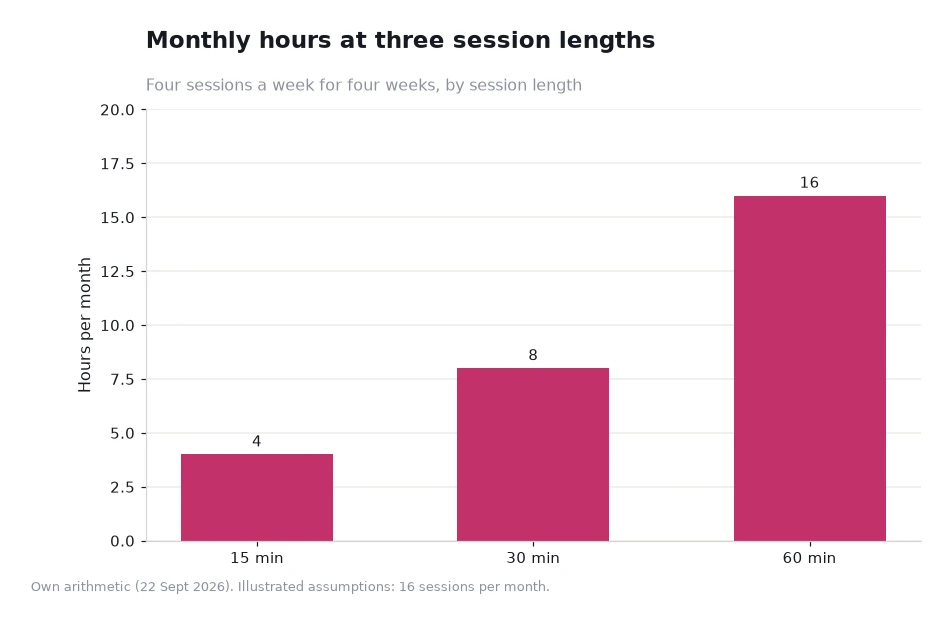
Take the regular pattern: four sessions a week for four weeks, so 16 sessions a month. At 15 minutes each that is 240 minutes, or 4.0 hours. At 30 minutes it is 480 minutes, or 8.0 hours. At 60 minutes it is 960 minutes, or 16.0 hours. Those figures are the ones the chart beside this section plots, and they are illustrative assumptions rather than platform data.
Now price the rules. Ten minutes to write the window, the stop signal and the boundary list is a one-off cost. A review every five sessions is roughly three reviews across 16 sessions, and if each takes four minutes that is 12 minutes a month. Add the two together and the whole arrangement costs about 22 minutes in the first month and 12 in each month afterwards — against 480 minutes of conversation at the 30-minute pattern, or 4.6% of the time it governs. The rules are not an overhead on the hobby; they are a rounding error that removes most of the friction.
The arithmetic also suggests why the review cadence matters more than the rules themselves. A rule set written once and never revisited becomes decoration, while 12 minutes a month keeps the frame current as the stories change.
Where to read the rules that are not yours
Individual ground rules sit inside a structure the platform sets. Its ai porn chat pages describe how the environment and its characters are meant to behave, the 2257 compliance statement defines what the content is, and the content removal policy describes how a concern about a profile is raised. The FAQ on the same site spells out what Porn Chat AI refers to, how realistic it describes the responses as being, and which limitations follow from its content and community guidelines — which is precisely the layer your own rules sit inside rather than replace. Reading all of it takes about ten minutes and answers most of what a new reader wants to know about the edges of the room.
Once they are read, the rest is routine. Decide the window, open the thread, hold the boundary, close the scene on purpose, and review every fifth session. That is the whole discipline, and it is the difference between a habit with a shape and one that simply accumulates.
Frequently asked questions
Does consent apply when the character is fiction?
Not as an agreement between participants, because there is only one adult involved. It applies as the frame you set for your own session: a window, a stop signal and a short boundary list.
Can I change the ground rules later?
Yes, and you should. The rules are yours, and a five-session review exists precisely so that they can be adjusted as the stories develop rather than being left as they were written.
What if a scene drifts somewhere I did not intend?
Use the stop signal. Ending a scene deliberately is not a failure of the fiction; it is the mechanism the fiction was set up to include, and it keeps the thread resumable.
Write the frame before the scene
Take ten minutes today to write three lines: the window, the stop signal and what this month's scenes will not include. Then set a review for every fifth session and keep it. The rules cost less than a single session's worth of time each month, and they are what make the difference between a story you are telling and one that is telling you.
Data and sources: the platform's description of its characters and its published FAQ wording, together with its compliance statement[1], read 22 Sept 2026. Session and review figures are illustrative assumptions. Content for adult readers 18+.