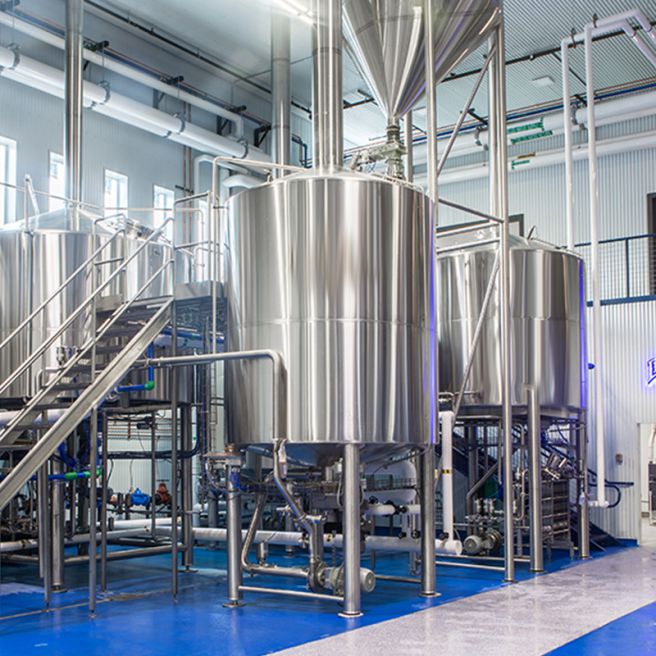
A brewhouse improves efficiency by recovering more extract from malt, shortening vessel occupancy, reducing water and steam use, and sending more of the produced wort to fermentation. A system running at 72% brewhouse efficiency has much more room for improvement than one consistently reaching 82–88%, but higher extract yield should not come from excessive sparging or longer boiling. Mill settings, mash pH, lauter flow, evaporation, heat recovery, CIP control, and transfer losses need to be measured together. A 5% gain in extract recovery across 500 annual brews can represent a substantial reduction in malt use without increasing brewhouse size.
Efficiency starts at the mill because the mash cannot recover extract that remains trapped inside poorly crushed kernels. A coarse crush leaves intact endosperm, while excessive flour increases grain-bed resistance during lautering. In many brewhouses using well-modified barley malt, operators try to preserve a large part of the husk while breaking the endosperm into several smaller particles. The mill gap should therefore be checked against actual grist samples instead of being treated as a permanent setting. A brewery processing 1,000 kg of malt per brew loses 30 kg of potential raw-material use for every 3% avoidable extract difference, before wort losses are counted.
That milling result becomes measurable during mashing. Commercial mash schedules usually operate within narrow temperature bands because a difference of only 2–3°C can change enzyme activity and wort composition. Beta-amylase is more active at lower saccharification temperatures, while alpha-amylase remains useful at higher temperatures, so a brewery making several beer styles should not use one temperature program for every recipe. Mash pH is commonly managed around 5.2–5.6 when measured near room temperature, with the exact target depending on malt, water profile, and beer style. A 2026 Brewers Association water resource also treats brewing-water adjustment as part of process control rather than a separate utility issue.
Temperature accuracy matters only when the mash is uniform. A sensor mounted near a steam jacket can report 67°C while a poorly mixed area of the vessel remains several degrees lower. Agitator speed, blade geometry, vessel diameter, and mash thickness all influence circulation. A plant running at 80% brewhouse yield should therefore compare temperature readings from repeat batches before trying to raise the number to 85%. Faster agitation is not automatically better because high shear can break husks and increase fine material reaching the lauter tun.
A useful efficiency record connects four numbers from the same brew: kilograms of malt loaded, extract potential of that malt, wort volume produced, and measured wort gravity. Without all four, an apparent 4% improvement may simply come from a change in raw material or measurement.
Once conversion is complete, lautering often sets the pace for the rest of the brewhouse. A 90-minute lauter extended to 120 minutes adds 30 minutes of vessel occupancy; across 400 brews per year, that is 200 production hours. Flow should be controlled by grain-bed condition rather than by opening the runoff valve as far as possible. Pulling wort too quickly can increase differential pressure, compress the bed, and slow the later part of runoff. Rakes can restore permeability, but aggressive or frequent cutting may disturb filtration and send more solids into the kettle.
Sparging creates another trade-off. Additional water can recover more extract, but every extra hectoliter entering the kettle must later be heated and, in many recipes, partially evaporated. Suppose a brewery gains only 1% more extract after adding 5 hL of late sparge water. The recovered sugar should be compared with the steam, boiling time, water treatment, and vessel time required to remove the added water. Stopping runoff based on gravity, volume, pH, and recipe specification is more repeatable than stopping because the lauter has reached a familiar number of minutes.
The kettle then moves the discussion from extract recovery to thermal efficiency. Evaporation must be high enough to support the required wort treatment, but unnecessary evaporation consumes steam and reduces finished wort volume. A brewhouse evaporating 10% of a 30 hL pre-boil volume removes about 3 hL of water; reducing the validated rate to 7% removes roughly 2.1 hL. That 0.9 hL difference has to be evaluated against DMS removal, hop utilization, wort concentration, foam formation, and the design of the kettle rather than against energy use alone.
| Measurement | What to record | Example operating question |
|---|---|---|
| Brewhouse yield | Malt input, laboratory extract, wort volume, gravity | Why did yield move from 82% to 77%? |
| Lauter time | First runoff to final transfer | Why did a 95-minute cycle become 115 minutes? |
| Evaporation | Pre-boil and post-boil volume | Is 9% required, or can the process meet specification at 7%? |
| Wort recovery | Kettle volume versus fermenter volume | Where is the missing 3–5% of wort? |
| Water use | Water volume per beer volume | Which operation caused the ratio to rise after 2025? |
| CIP time | Fill, wash, rinse, drain, recovery | Can a 50-minute rinse meet the same endpoint in 35 minutes? |
Boiling performance also depends on heat-transfer condition. Scale and organic deposits act as thermal resistance, so the same steam pressure may take longer to raise wort from 75°C to boiling after months of poor maintenance. A heat-up stage that increases from 35 to 45 minutes adds almost 29% more time to that operation. Steam traps, jackets, condensate lines, burners, electrical heating elements, and kettle surfaces should therefore be checked when heating time starts increasing instead of compensating by changing the recipe schedule.
Heat leaving the brewhouse can be reused before more energy is purchased. During wort cooling, a plate heat exchanger can move a large share of wort heat into brewing water. If 20 hL of hot wort is cooled while the brewery simultaneously prepares hot liquor for the next brew, recovered water can reduce the amount of cold water that must be heated from supply temperature. The Brewers Association documented a brewery case in its 2017 benchmarking report where recovered process water and other energy measures prevented about 7,500 gallons of potable water per week from going to wastewater, while cogeneration waste heat offset 95% of steam required for process water at that facility.
Heat recovery works better when tank capacity and production timing match each other. Recovering 25 hL of hot water has limited use if the hot-liquor tank has room for only 8 hL. A brewery planning two or three brews per day should calculate when hot water is produced, when mash and sparge water are needed, and how much storage is available between those events. When specifying craft beer equipment, hot-liquor capacity, heat-exchanger size, steam supply, pipe diameter, and pump flow deserve the same attention as nominal brewhouse volume.
Water measurement should then extend beyond the brewhouse vessels. Brewers Association guidance notes that facilities without effective water-conservation programs can use more than 10 gallons of water for each gallon of beer produced. A brewery cannot correct that ratio using one building-level water meter because the reading does not show whether the loss came from CIP, wort cooling, floor washing, packaging, hoses, or utilities. Sub-metering major users gives operators a batch-level number that can be compared with production volume.
Cleaning data deserves the same treatment. A CIP program might use a 20-minute caustic circulation followed by a fixed 20-minute rinse even when conductivity reaches the required rinse endpoint after 12 minutes. Across 500 cycles, removing 8 unnecessary minutes saves about 67 hours of rinse time as well as water. Chemical concentration, temperature, flow, mechanical coverage, contact time, and final rinse condition should still remain within the brewery's validated sanitation program; reducing time without measuring cleaning performance can create larger production losses later.
Transfer losses are easier to overlook because they are spread across pipes, pumps, vessel cones, trub, and heat exchangers. Losing 4% of a 20 hL knockout leaves 0.8 hL outside the fermenter. Repeated across 500 brews, the annual difference reaches 400 hL before fermentation and packaging losses. Shorter sanitary pipe runs, drainable valve arrangements, correctly sized pumps, low-hold-up heat exchangers, and properly positioned vessel outlets can reduce retained wort without changing mash efficiency at all.
Automation is useful when it makes those measurements repeatable. Flowmeters can stop mash or sparge water at a programmed volume; variable-frequency drives can maintain controlled pump flow; pressure measurement can show changes across a lauter bed; temperature transmitters can record heating performance; automated valves can repeat transfer routes. A brewhouse moving from manual volume estimates with ±5% variation to properly calibrated metering with much tighter repeatability can reduce recipe-to-recipe correction work, but calibration still matters. An automated meter that reads 3% high repeats the same error on every batch.
Production records should finally be reviewed as a connected set rather than as isolated efficiency numbers. The Brewers Association released a brewhouse efficiency tool in 2026 specifically to help breweries analyze efficiency and estimate possible cost savings. For each brew, a practical record can include malt weight, malt extract specification, mash pH, mash temperature, lauter duration, first and final runoff gravity, pre-boil volume, post-boil volume, evaporation percentage, knockout volume, water use, steam or gas use, CIP duration, and fermenter volume.
A brewery operating at 84% yield on ten consecutive batches has a different process condition from one averaging 84% while individual batches range from 76% to 91%. The average is identical, but the second brewhouse requires repeated recipe correction, gravity adjustment, or volume adjustment. Reviewing at least 20–30 comparable batches makes it easier to separate normal recipe differences from equipment or operating changes, especially after adjusting mill gap, rake speed, pump frequency, heating settings, or CIP timing.
Capacity should be checked with the same numbers before another vessel is purchased. Cutting 20 minutes from a six-hour brew cycle reduces cycle time by about 5.6%; over three brews per day, the recovered hour may remove a scheduling conflict without increasing vessel volume. If the lauter tun is waiting 25 minutes for an occupied kettle, however, improving mash speed will not increase daily output. Timestamping mash-in, transfer, runoff, boil, whirlpool, cooling, CIP, and vessel-release events shows where production time is actually being used.
The useful target is not the highest possible percentage on one brew. A brewhouse that repeatedly delivers 82–86% extract efficiency, controlled evaporation, predictable cycle time, measured water consumption, and low transfer loss is easier to schedule and operate than a system that occasionally reaches 90% while requiring longer sparging, more steam, or frequent manual correction. Measurements should therefore be compared over enough batches to show whether a change reduces malt, water, energy, labor, or vessel time while keeping wort within the brewery's established specification.